In my first column, I traced the evolution of the Towards Sustainable Mining (TSM/VDMD) initiative since 2004 and the crucial role external verification has played in its credibility.
This story is now entering a new chapter.
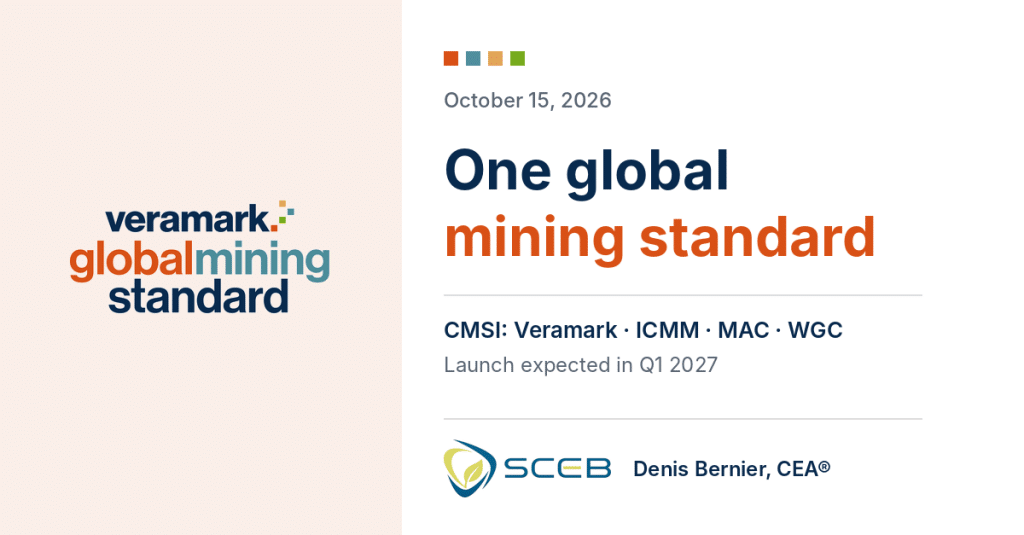
October 15, 2026 marks a major milestone: The Copper Mark officially becomes Veramark Assurance. At the same time, the global standard being developed under the Consolidated Mining Standard Initiative (CMSI) will be named the Veramark Global Mining Standard. Its launch is anticipated in the first quarter of 2027, subject to final approval by the Veramark Board of Directors.
An important distinction must be made: the CMSI itself is not changing its name. It remains the consolidation initiative uniting four major responsible mining frameworks. Veramark Assurance will become the organization responsible for the resulting standard and its implementation.
Author: Denis Bernier, Eng., M.Env., CESA® | SCEB Inc.
TSM Verifier since 2006 • The Copper Mark / Veramark Assurance Assessor
From Gradual Evolution to Global Consolidation
Since 2004, TSM has developed in stages. New protocols were added, requirements were refined, and external verification became a central mechanism for credibility.
During the same period, other frameworks also gained international prominence. While this multiplication of standards drove improvements in practices, it also created real complexity: a single organization might have to comply with multiple systems addressing similar issues, but using different criteria, evaluation methods, and assurance processes.
For compliance and ESG performance teams, this often leads to parallel assessments, repeated requests for evidence, and administrative overlap. The CMSI specifically aims to reduce this complexity.
From CMSI to the Veramark Global Mining Standard
The CMSI is a collaboration between Veramark Assurance (formerly The Copper Mark), the ICMM, the Mining Association of Canada (MAC), and the World Gold Council.
The initiative brings together the core achievements of four major frameworks:
- The Towards Sustainable Mining initiative (TSM);
- The Copper Mark assurance system;
- The ICMM Mining Principles;
- The World Gold Council’s Responsible Gold Mining Principles.
The goal is ambitious: to establish a common global standard impacting nearly 100 companies and approximately 600 facilities across around 60 countries. If realized, this standard will achieve a reach rarely attained by a voluntary standard in the mining sector.
A Structure Built on 24 Performance Areas
The draft consolidated standard features 24 performance areas, categorized across three performance levels:
- Towards Good Practice (Entry point)
- Good Practice (Aligned with international standards)
- Leading Practice (Excellence and leadership)
This structure incorporates a foundational principle of TSM: continuous improvement. The goal is not merely to determine whether a facility meets a requirement, but to measure its progress and encourage advancing practices over time.
Preserving TSM’s Legacy and Rigor
After twenty years of TSM verification, I believe the true value of a program lies not just in its protocols or scoring system. Its primary strength remains the requirement to translate commitments into verifiable practices at the facility level.
“The real challenge will not be regrouping requirements into a new checklist. It will be preserving what gives a framework its credibility: clear expectations, verifiable evidence, and an assurance process capable of distinguishing a well-documented system from one that is genuinely implemented.”
A well-written policy does not prove a risk is controlled. An approved procedure does not guarantee it is applied. Performance must be demonstrated through a coherent blend of documentation, records, site observations, interviews, and verified data.
A Seamless Transition
For existing facilities, published information confirms there will be no abrupt rupture:
- Recognitions remain valid: Currently awarded marks remain valid, and existing assurance cycles will proceed as planned.
- Current guides remain in force: The Risk Readiness Assessment Criteria Guide 3.0 remains applicable until sites complete their transition.
- Assessor continuity: Current approval statuses are maintained. Supplemental training on the new standards will be provided to verifiers before conducting assessments under the new framework.
Official Transition Timeline
| Timeline | Milestone |
| October 15, 2026 | The Copper Mark officially becomes Veramark Assurance (9:00 AM EDT). |
| October 28, 2026 | Launch of the Responsible Metals Value Chain Platform. |
| November 2026 | Entry into force of the expanded Veramark Chain of Custody Standard (copper, molybdenum, nickel, zinc). |
| November 30, 2026 | First Responsible Metals Value Chain Forum. |
| Q1 2027 | Anticipated launch of the Veramark Global Mining Standard. |
| Subsequent Years | Gradual transition of sites according to their regular assurance cycles. |
Preparing Today Without Assuming Final Requirements
While the standard is currently being finalized, organizations can already take concrete steps:
- Map current practices against the 24 proposed performance areas;
- Identify overlaps and bridge information gaps;
- Evaluate ESG data quality, traceability, and governance;
- Prepare a risk-based transition plan aligned with the site’s assurance cycle.
In Conclusion
The success of this convergence will not be measured solely by the number of participating companies. It hinges on one essential condition: preserving the obligation to demonstrate performance, not just declare it.
💬 Over to you: In your organizations, do you see this consolidation as administrative relief, or do you anticipate challenges during the transition period?
(Upcoming article: Mine Tailings — Have We Truly Reduced the Risk?)